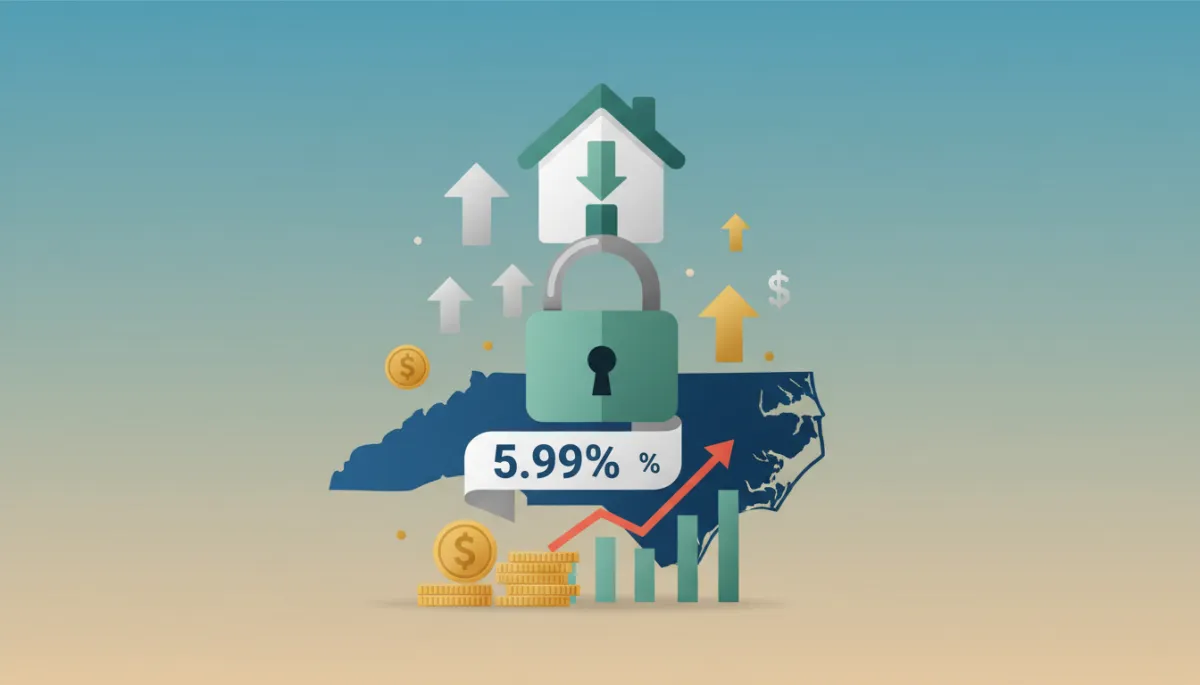
Secure 5.99% Mortgage Rates in North Carolina
Real Estate, Mortgage Rates, North Carolina
Mortgage Rate Lockouts: How Smart Buyers Are Using Rate Buydowns to Grab 5.99% Financing in North Carolina
With 30-year mortgage rates in North Carolina hovering in the low-to-mid 6% range, many homeowners feel “locked out” of moving. Yet a growing group of savvy buyers are using rate buydowns and strategic rate locks to secure financing as low as 5.99%—without waiting for the Federal Reserve to make the next move.
The Mortgage “Rate Lockout” Problem in North Carolina
Across North Carolina, thousands of homeowners are sitting on ultra-low pandemic-era mortgages—often at 3–4% or less. Trading that in for a new loan at 6%+ can feel like a non-starter, even if they’ve outgrown their home. Economists call this a mortgage rate lockout or “lock-in effect”: people stay put because today’s rates make moving painfully expensive.
As of August 2026, major sources show 30-year fixed rates in North Carolina generally between about 6.24% and 7.05%—for example, Rate Direct lists a benchmark conventional 30-year at 6.24% (APR 6.276%), while Rocket Mortgage via Redfin shows 7.052% APR for a similar term. FHA and VA loans are somewhat lower, around 5.75% in some scenarios, but that’s still well above pandemic lows.
The result? Many would-be sellers delay listing, shrinking inventory. And buyers—especially first-timers—are squeezed by both higher prices and higher payments. That’s where targeted strategies like rate buydowns and smart use of rate locks come in, helping some borrowers land eye-catching offers such as 5.99% financing, even while headline rates remain higher.
How Rate Buydowns Work: Turning 6.5% Headlines into 5.99% Reality
A rate buydown is a way to temporarily or permanently lower your interest rate by paying extra money up front—often funded by the seller or builder as a concession. In 2026, the most common structures nationally are:
2-1 buydown: Your rate is reduced by 2% in year one and 1% in year two, then returns to the full note rate in year three and beyond.
1-0 buydown: Your rate is 1% lower in year one, then steps up to the regular rate.
Industry data from ICE Mortgage Technology shows that 2-1 buydowns account for roughly 60% of all buydown structures, with 1-0 options making up about 30%. Builders in particular have leaned into this strategy: one major builder-affiliated lender, K. Hovnanian American Mortgage, reported that around 74–78% of their customers used some form of buydown between late 2025 and mid‑2026.
For North Carolina buyers, this can translate into marketing offers like “5.99% for the first two years” or “5.99% 30-year fixed with seller-paid buydown.” The underlying market rate might still be around 6.25–6.75%, but the buydown subsidy covers the difference for a set period, giving you breathing room on monthly payments and helping you qualify more easily.
💡 Pro Tip: Ask whether the buydown is temporary (2-1 or 1-0) or permanent. A permanent buydown uses discount points to reduce your rate for the life of the loan, while a temporary buydown only lowers payments for the first few years.
Why 5.99% Financing Stands Out in Today’s NC Market
When typical 30-year fixed rates in North Carolina are around 6.3–6.8%, a mortgage starting at 5.99% is more than just a psychological milestone. It can meaningfully reduce your monthly payment and expand your purchasing power, especially on higher-priced homes in markets like Raleigh, Charlotte, or Wilmington.
For example, Realtor.com notes that dropping a rate from 6% to 4% on a $300,000 loan can cut the monthly principal and interest by roughly $366. While a buydown from about 6.5% to 5.99% won’t be that dramatic, it can still shave hundreds of dollars per month in the early years—often enough to make a new home feel affordable instead of out of reach.
Some North Carolina lenders pair buydowns with already competitive FHA or VA rates. With FHA and VA 30‑year loans sometimes pricing around 5.75% in August 2026, a modest permanent buydown or seller credit can realistically bring your effective starting rate close to, or even slightly below, 5.99%—if you qualify for those programs.

Even a small rate drop toward 5.99% can save North Carolina buyers hundreds monthly.
Navigating Rate Locks in North Carolina: Protecting Your 5.99% Offer
Securing a great rate is only half the battle—you also need to lock it in long enough to close. A mortgage rate lock (or “lock-in”) is an agreement with your lender that guarantees a specific interest rate for a set period, typically 30–60 days, as long as your application details don’t change and you close on time, according to the Consumer Financial Protection Bureau.
North Carolina adds an extra layer of consumer protection. Under state rules (4 NCAC 03I.0706), if you choose to lock your rate or pay a lock-in fee, the mortgage banker must provide a written lock-in agreement within three business days of your application. That agreement must spell out:
Your interest rate and any points
The lock expiration date and lock period length
Any lock-in or commitment fees and whether they’re refundable
The source of funding for the loan
For buyers using the NC Home Advantage Mortgage™ through the North Carolina Housing Finance Agency, the standard lock is 60 days, with options to extend for 7, 15, or 30 days for a small fee (for example, 0.0625% for a 7‑day extension, 0.25% for 30 days). Extensions must be requested before the lock expires, or you may face mark‑to‑market fees if rates rise before the loan is purchased by the program’s master servicer.
📌 Key Takeaway: If a lender or builder is advertising 5.99% with a buydown, ask exactly how long that rate can be locked, what it costs to extend, and what happens if your closing is delayed.
Is a Rate Buydown to 5.99% the Right Move for You?
Rate buydowns and aggressive rate locks are powerful tools, but they’re not one-size-fits-all. Freddie Mac’s research shows that borrowers using temporary buydowns often pay slightly higher base rates—around 0.15 percentage points more on average—reflecting the trade-off between early savings and overall cost. You’ll want to weigh:
Who’s paying for the buydown? A seller- or builder-paid buydown is usually more attractive than paying points out of your own pocket.
How long you’ll stay in the home. If you expect to move or refinance within a few years, a temporary buydown paired with a 5.99% starting rate may be ideal.
Your monthly budget. If the only way the payment fits is with a buydown, be realistic about what happens when the rate steps up.
In a high-rate environment where many homeowners feel stuck, smart North Carolina buyers are using rate buydowns and well-structured rate locks to break through the mortgage rate lockout. By combining today’s programs with careful planning, it’s possible to secure financing around 5.99%—and finally make your next move, even while the rest of the market waits on the sidelines.
