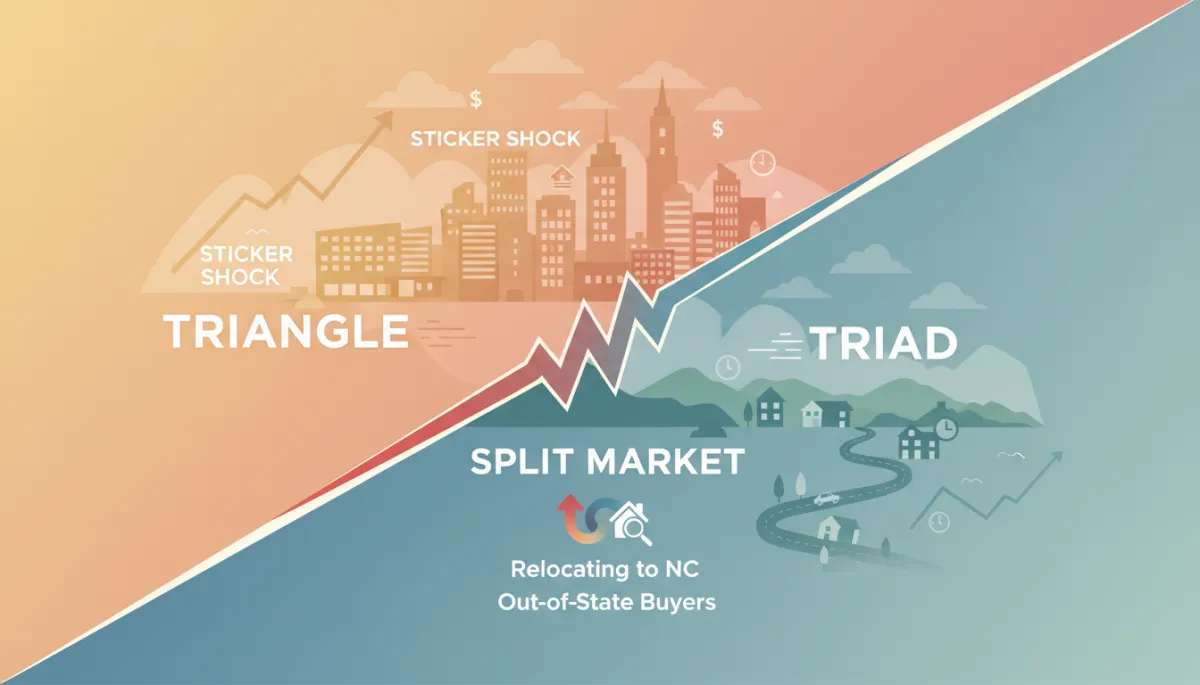
Relocating to NC: Triangle vs. Triad Market Guide
Relocation, North Carolina Real Estate, Triangle vs. Triad
Relocating to NC? The “Split Market” Guide for Out-of-State Buyers
Thinking about moving to North Carolina in 2026? You’re not alone. The state continues to attract tens of thousands of new residents each year, but the housing market you’ll meet when you arrive is very different from the headlines of a few years ago. This guide unpacks today’s “split market” reality—especially between the Triangle and Triad—and walks you through a clear, step-by-step relocation strategy.
1. The 2026 North Carolina Market: Stable, Busy, and Very Local
North Carolina’s housing market in mid‑2026 is no longer the runaway train it was during the pandemic years—but it’s far from sleepy. Statewide, the median home sale price sits around $370K–$380K, with year-over-year price changes in the low single digits. Some sources show modest gains of about 1–4%, while others show a slight dip of under 1%, signaling a cooling but not a crash (Redfin, Zillow, Houzeo).
Inventory is also slowly improving. Depending on the source, the state hovers between roughly 2 and 4 months of supply, up notably from the ultra-tight conditions of 2021–2023. The North Carolina REALTORS association recently reported about 2.8 months of supply, up 15% from a year ago, pointing to a gradual move toward balance rather than a buyer or seller stampede in either direction.
Mortgage rates, meanwhile, are still higher than many buyers remember. The 30‑year fixed rate has been holding in the 6–7% range, down from the 2023 peak but well above the sub‑3% era. That’s keeping some existing owners “locked in” to their low-rate loans, limiting resale inventory even as building permits ramp up and new construction increases by more than 30% year over year in some reports (Richmond Fed, Cinch Homebuyers).
📌 Key Takeaway: Statewide, North Carolina is in a stabilizing phase: modest price moves, slowly rising inventory, and more room for negotiation—especially outside the hottest metros.
2. Understanding the “Split Market”: Triangle vs. Triad in 2026
When out-of-state buyers talk about North Carolina, they often lump everything together: “Raleigh, Durham, Greensboro—it’s all the same, right?” In 2026, that couldn’t be further from the truth. You’re stepping into what many local agents describe as a split market: one state, but very different realities depending on where you look.
The Triangle: Strong Jobs, Higher Prices, Faster Pace
The Triangle—Raleigh, Durham, Chapel Hill and surrounding suburbs—remains one of the state’s economic engines. Anchored by major universities, tech and life-science employers, and a steady inflow of high-paying jobs, this region has held onto much of its pandemic-era price growth. Median home prices generally sit in the $425K–$450K range, with some submarkets like Chapel Hill trending even higher (Axios, regional MLS summaries).
After several years of bidding wars and sight-unseen offers, the Triangle has shifted into what local analysts call a “balanced, but still competitive” market. Inventory in Wake County has risen by more than 20% year over year, days on market have stretched to around 50–60 days on average, and frenzied over-asking battles are less common—but well-priced homes in popular school districts still move quickly and attract multiple offers (WRAL, Sizemore Residential).
💡 Think of the Triangle as: higher sticker prices, but strong long-term demand, job growth, and resale potential. It still leans slightly seller-friendly, especially in prime locations.
The Triad: Greensboro–Winston‑Salem–High Point and the Value Play
Head west along I‑40 and you’ll hit the Piedmont Triad: Greensboro, Winston‑Salem, and High Point. Here, the story is very different. Affordability and value are the main headline. Median prices are in the $285K–$315K range—often more than $100,000 less than comparable homes in the Triangle (HomesInTriadNC).
PropertyIQ affordability scores underline this gap: Greensboro and Winston‑Salem both score above the national median for value, while Raleigh and Durham score below it. A household earning around $60,000 per year may be priced out of many Triangle and Charlotte neighborhoods—but can still comfortably buy in the Triad. At the same time, the Triad isn’t stagnant: some cities, like High Point, have seen double-digit annual appreciation, with High Point’s median up about 12.5% year over year (HomesInTriadNC).
Inventory here is also different. While some statewide data puts the Triad around 3–5 months of supply, local April 2026 reports show roughly 5 months—a clear tilt toward buyers compared with the Triangle’s tighter 2–3 months. Entry-level homes under $250K still move quickly, but mid-range and older homes can linger, especially if they need updating. That creates room for negotiation and value-add opportunities for patient buyers and investors.
In the Triad, well-priced homes linger longer, giving buyers more leverage.
Why the Market Is “Split”
Job concentration: The Triangle has dense clusters of tech, biotech, and higher-education employers; the Triad’s employment base is more diversified and less salary-heavy, which tempers price pressure.
In-migration patterns: Many high-income remote workers and corporate relocations target Raleigh–Durham and Charlotte first. The Triad attracts a mix of local movers, first-time buyers, value-focused retirees, and investors, leading to steadier, less explosive growth.
New construction and zoning: The Triangle is wrestling with limited land and zoning constraints (though places like Chapel Hill are reforming rules to add “missing middle” housing), while Triad suburbs still have room for new subdivisions and more flexible land costs.
📌 Split Market Summary: The Triangle is higher-priced, faster-moving, and job-dense. The Triad is more affordable, slower-paced, and negotiation-friendly. Both are growing—but on very different terms.
3. “Sticker Shock” vs. “Speed Shock”: Two Surprises for Out-of-State Buyers
If you’re relocating from a high-cost state like California, New York, or Massachusetts, North Carolina prices may initially look like a bargain. But once you drill into specific metros—and how quickly good homes move—you’ll likely encounter two distinct shocks: Sticker Shock and Speed Shock.
Sticker Shock: “Wait, This Isn’t as Cheap as I Expected.”
Many buyers arrive expecting every North Carolina city to be dramatically cheaper than their current market. That’s partly true—but only in some regions. In the Triangle and parts of Charlotte, a modern 3‑bedroom home in a top school district can easily run $500K–$700K+, especially for new construction or walkable neighborhoods. Luxury homes in the Triangle’s top 5% price tier still cluster around the $1M mark, even after a recent softening at the high end.
The surprise for many: North Carolina is not one uniform “cheap” market. It’s a patchwork. You may be able to buy a large, updated home in Winston‑Salem or Greensboro for what a townhouse costs in Raleigh’s hottest ZIP codes. Understanding that spread is key to avoiding disappointment—or overpaying because you assume “everything is still a deal.”
Speed Shock: “I Thought the Market Cooled—Why Did That House Disappear?”
On the flip side, buyers who have heard that the market has “normalized” sometimes expect to have weeks to think about every listing. That’s only half right. Statewide, median days on market have stretched to around 50–60 days, but that figure hides a split personality:
In the Triangle, well-priced homes in desirable areas can still go under contract in a matter of days, especially if they’re move-in ready and under local median price.
In the Triad, some properties sit for weeks or months, particularly older homes or those priced ambitiously for the neighborhood.
This is the essence of Speed Shock: you may have time to negotiate in the Triad, but in certain Triangle micro-markets, you’ll still need to be prepared to move quickly on the right home. Out-of-state buyers who expect a uniformly slow, buyer-dominated market can miss opportunities simply because they’re not ready to act when a strong listing appears.
📌 Quick Rule of Thumb: Assume Triangle = faster decisions, tighter inventory. Assume Triad = more room to negotiate, longer timelines—but still be prepared when a standout home hits the market.
4. Step-by-Step Relocation Strategy for Out-of-State Buyers
Step 1: Clarify Your Non-Negotiables and Time Horizon
Before you fall in love with a particular city’s marketing, get clear on what matters most to you over the next 5–10 years:
Commute or remote work flexibility
School quality and special programs (STEM, arts, language immersion)
Walkability vs. larger lots and privacy
Budget ceiling (including taxes, insurance, HOA, and utilities)
Decide whether this move is a 5-year stepping stone or a 10–15-year “forever-ish” home. In a split market, that time horizon can nudge you toward either the Triangle (for long-term job and appreciation potential) or the Triad (for immediate affordability and lifestyle space).
Step 2: Choose Your Region—Triangle vs. Triad (or Both)
Next, align your goals with each region’s strengths:
Choose the Triangle if you prioritize: strong job options, top-tier universities, higher walkability, and long-term appreciation in exchange for higher prices and more competition.
Choose the Triad if you prioritize: lower purchase price, more house for the money, quieter pace, and the ability to keep your monthly payment comfortable even at 6–7% interest rates.
Many out-of-state buyers also consider a “both/and” strategy: renting in the Triangle for a year to test job and lifestyle fit, while purchasing an investment or future-retirement property in the Triad where prices are lower and cash flow potential can be stronger.
Step 3: Get Pre-Approved with a Local Lender
In a split market, speed and clarity matter. A North Carolina–based lender will understand local taxes, insurance norms, and HOA fees, giving you a more accurate payment estimate than a generic online calculator. With rates in the mid‑6% range, even small differences in taxes or HOA dues can affect your comfort zone.
💡 Pro Tip: Ask your lender to run side-by-side scenarios: one at today’s rate and one 0.5–1% lower. It helps you decide whether to “marry the house, date the rate” and refinance later or stay more conservative now.
Step 4: Partner with a Local Agent Who Understands Both Sides of the Split
Not every agent works both the Triangle and Triad, but you’ll want someone who at least understands how they compare. Ask potential agents:
How quickly are well-priced homes selling in my target price range?
How often are you seeing price reductions or seller concessions right now?
Can you share recent examples of buyers negotiating repairs, closing costs, or below-asking prices?
Their answers will immediately tell you whether they’re tuned into 2026 realities—or still selling the 2021 story.
Step 5: Plan a “Split Market” Scouting Trip
If your schedule allows, spend at least 2–3 days in each region you’re considering. In the Triangle, tour a mix of price points and school districts; in the Triad, compare established neighborhoods with new-construction communities in suburbs like Clemmons, Kernersville, or northern Guilford County. Take notes on:
Commute times at rush hour
Traffic patterns, grocery and healthcare access, and parks or trails
How each area feels at night and on weekends
Step 6: Use Negotiation Strategically—Based on Local Conditions
In a balanced or slightly buyer-leaning market, negotiation isn’t just allowed—it’s expected. But what you can reasonably ask for differs between the Triangle and Triad:
In the Triangle, you may still need to offer near asking price for a well-presented home, but you can often negotiate on closing dates, minor repairs, or modest seller credits—especially if the home has been on the market for more than 30 days or has had a recent price reduction.
In the Triad, where some cities have close to 5 months of inventory, you may have room to request seller-paid closing costs, larger repair concessions, or a price adjustment, particularly on homes that have sat 45+ days.
💡 Negotiation Tip: Focus on total cost of ownership, not just price. A slightly higher purchase price with a seller credit to buy down your interest rate can save you more per month than a small discount with no concessions.
Step 7: Inspect Thoroughly and Think Long-Term
Whether you buy in the Triangle or Triad, don’t skip due diligence. Have a reputable inspector check for age-related issues (HVAC, roof, windows), moisture problems, and energy efficiency. With insurance and utility costs rising nationwide, buyers in 2026 are increasingly weighing ongoing costs alongside purchase price. Use inspection findings to negotiate fair repairs or credits, especially in the Triad where buyers hold more leverage.
5. Choosing the Right Area Based on Your Goals
If Your Priority Is Career Growth and Resale Potential
The Triangle is hard to beat for high-growth industries, networking, and long-term demand. If you work in tech, healthcare, research, or higher education—or expect to change employers within the region—Raleigh, Durham, Chapel Hill, and their suburbs offer deep job markets and a track record of resilient appreciation. You’ll pay more upfront, but you’re also buying into an ecosystem that tends to hold value even when the broader market softens.
If Your Priority Is Space, Affordability, and Lifestyle
The Triad shines for buyers who want more house and yard for the money. If you’re bringing a family, pets, or hobbies that require space—gardening, a workshop, or a home studio—the Triad often lets you buy a larger, newer home without stretching your budget to the breaking point. Property taxes also tend to be lower than in Mecklenburg County (Charlotte) and competitive with much of the Triangle, which can save you thousands over time.
If You’re an Investor or Planning for Retirement
Both regions offer opportunity, but in different ways:
The Triangle may appeal for long-term appreciation and low vacancy rates, especially near universities and major employers.
The Triad may deliver stronger cash flow and lower entry prices, particularly for single-family rentals and value-add properties in growing suburbs.
For retirees or near-retirees relocating from higher-cost states, a common strategy is to buy in the Triad—often in established neighborhoods or golf-course communities—where luxury-style homes can cost 30–50% less than comparable properties in Raleigh or Charlotte, with lower annual tax bills as well.
6. Final Thoughts: Thriving in North Carolina’s Split Market
North Carolina in 2026 is not a one-size-fits-all housing story. It’s a split market where the Triangle and Triad—and other regions like Charlotte, the coast, and the mountains—each behave differently. Statewide trends show stabilization: modest price changes, gradually rising inventory, and more balanced negotiating power. But your experience on the ground will depend heavily on where you shop and how you prepare.
As an out-of-state buyer, your advantage is information. By understanding the difference between Sticker Shock and Speed Shock, recognizing why the market is split between the Triangle and Triad, and following a clear relocation strategy—from clarifying your goals to negotiating smartly—you can turn a complex move into a confident, well-timed decision.
Whether you land in a bustling Triangle suburb or a tree-lined Triad cul-de-sac, North Carolina still offers what so many newcomers are seeking: a strong quality of life, relative affordability compared with many coastal markets, and communities that are planning for long-term growth. The key is to match your goals to the right corner of this diverse, fast-evolving state—and to work with local professionals who can help you navigate every step of the journey.
