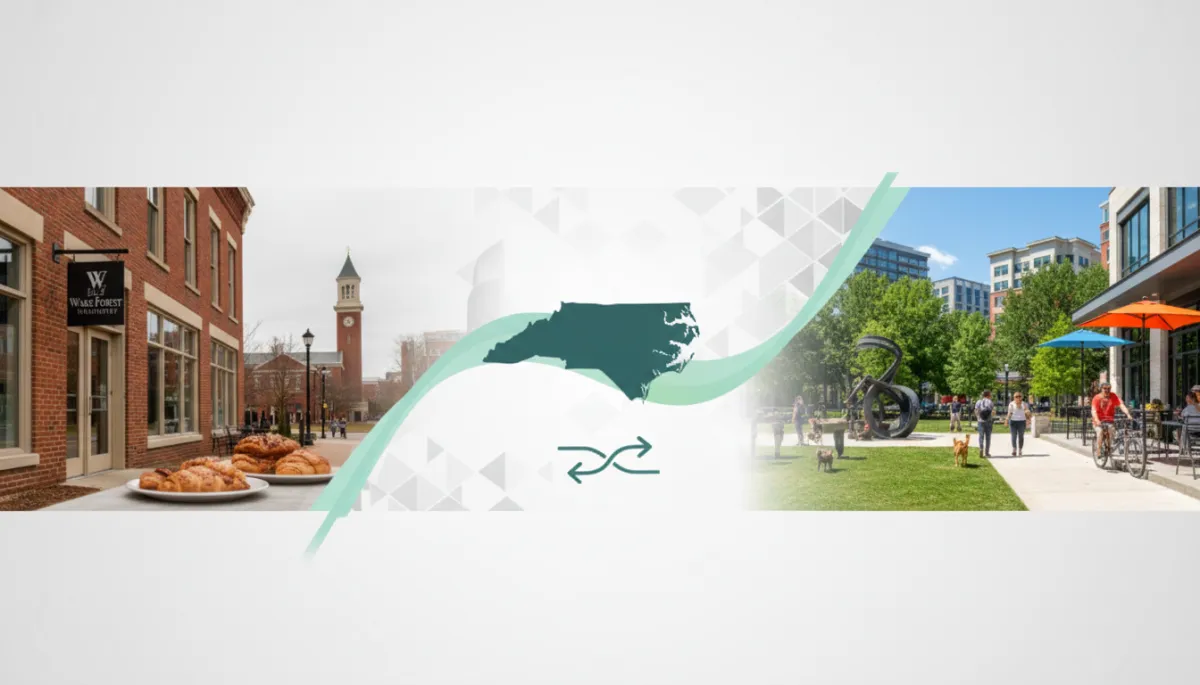
Winston-Salem vs. Greensboro: NC Triad Living Guide
Relocation, North Carolina Triad, Winston-Salem, Greensboro
Moving to the NC Triad? The Ultimate Local’s Guide to Winston-Salem vs. Greensboro Lifestyles
Thinking about putting down roots in North Carolina’s Triad and torn between Winston-Salem and Greensboro? Both cities offer Southern charm, reasonable prices, and growing opportunity—but the day-to-day lifestyle in each feels surprisingly different. This guide walks you through what life really looks like in each city so you can choose the place that fits your routine, priorities, and personality.
First, Meet the NC Triad: Two Cities, One Connected Region
The North Carolina Triad—anchored by Winston-Salem, Greensboro, and High Point—sits roughly halfway between Charlotte and Raleigh. It’s a region known for its universities, manufacturing roots, and increasingly, for being a sweet spot between big-city amenities and small-town ease. Commuting between Winston-Salem and Greensboro typically takes 30–40 minutes via I‑40, so it’s common for residents to live in one city and work, study, or socialize in the other.
Both cities are growing, but not at a breakneck pace. Winston-Salem’s population sits near 259,000, while Greensboro has passed 313,000 residents as of 2026, with Greensboro growing slightly faster. That means you’ll find new development and job opportunities, but you’re not dealing with the congestion or prices of Raleigh or Charlotte.
Cost of Living: Two Affordable Cities with Subtle Differences
If you’re moving from a high-cost market, both Winston-Salem and Greensboro will likely feel refreshingly affordable. Guides place Winston-Salem’s overall cost-of-living index around 84–88, or roughly 12–16% below the national average, with Greensboro landing at a similar 5–12% below average depending on the source (NC Paycheck Calculator, Salary.com).
Housing and Rent
Housing is where you’ll notice the most meaningful differences, though they’re still relatively modest:
Winston-Salem: Median home value is around $265,000 as of spring 2026, with some estimates placing it closer to $280,000 (Zillow, NC Paycheck Calculator). One-bedroom rents often range from about $700–$1,100 depending on neighborhood, with two-bedrooms around $1,100 per month.
Greensboro: Median home prices hover around $221,000–$245,000, depending on the source (City Affordability, NC Paycheck Calculator). Median one-bedroom rent is often quoted near $947–$1,200, with some downtown units pushing higher. Two-bedrooms can reach $1,450 in popular areas.
Various comparison tools disagree slightly—some show Winston-Salem cheaper overall, others give Greensboro a small edge—but the big picture is clear: both are significantly more affordable than major East Coast metros, and the gap between the two cities is usually in the single digits percentage-wise (CostToLive, LivingCostIndex).
Everyday Expenses and Healthcare
Beyond rent and mortgage payments, Winston-Salem often wins on groceries and transportation, with some estimates showing groceries about 13% cheaper and transportation costs roughly 13.6% lower than Greensboro. However, Winston-Salem’s healthcare costs can run significantly higher—nearly 39% above Greensboro’s in one comparison (LivingCostIndex).
Greensboro, by contrast, tends to offer slightly lower healthcare costs and utilities that hover around or just below the national average, making it attractive for families and retirees who prioritize medical access and predictable monthly bills (Salary.com).
💡 Budget Tip: If you’re young, healthy, and car-dependent, Winston-Salem’s lower housing, grocery, and transportation costs may stretch your paycheck further. If you anticipate frequent medical care, Greensboro’s lower healthcare costs could balance out slightly higher rents.
Winston-Salem Lifestyle: Artsy, Laid-Back, and Quietly Sophisticated
Winston-Salem wears the nickname “City of Arts and Innovation” for good reason. Once a tobacco and textile powerhouse, it has reinvented itself as a hub for arts, higher education, and entrepreneurship. The city’s pace is relaxed—many locals describe it as calm and “a little sleepy,” but in a way that feels intentional rather than stagnant (Reddit).
Neighborhoods and Housing Feel
Winston-Salem’s housing stock is a mix of historic homes, leafy established neighborhoods, and newer suburban developments. You’ll find charming older homes near downtown and in areas like Ardmore, West End, and Buena Vista, while newer subdivisions spread outward toward Clemmons and Lewisville. With median home values in the mid‑$200,000s and rents often below $1,200 for modest apartments, it’s especially appealing for first-time buyers and remote workers who want space without breaking the bank (NC Paycheck Calculator).
Culture, Dining, and Nightlife in Winston-Salem
For a mid-sized city, Winston-Salem punches above its weight in food, coffee, and culture. Local guides highlight a surprisingly sophisticated dining scene, from Mission Pizza Napoletana—frequently ranked among the best pizzerias in America—to beloved spots like Mozelle’s Southern Bistro and The Katharine Brasserie & Bar (Homes in Triad NC).
Coffee shops, bakeries, and craft breweries dot the downtown and Innovation Quarter area, giving the city a creative, slightly bohemian energy—especially around the campuses of Wake Forest University and the UNC School of the Arts. You’ll find galleries, performance spaces, and film festivals that reflect the city’s strong arts-school presence.
Nightlife, however, is where opinions split. Many residents say Winston-Salem is “quiet after 10 p.m.” and that younger singles may find the bar and club scene limited compared with Charlotte or Raleigh. If your ideal Friday night involves breweries, intimate music venues, or dinner with friends, you’ll be happy here. If you’re looking for packed nightclubs and a fast-paced downtown, you might feel underwhelmed (Reddit).
Outdoors and Everyday Recreation in Winston-Salem
Winston-Salem is an easy fit for people who want quick access to green space without leaving town. Locals rave about:
Salem Lake, with its scenic loop trail for walking, running, and biking, plus fishing and paddle sports.
Reynolda Gardens, a historic estate turned public garden and green space near Wake Forest, perfect for quiet walks and picnics.
Tanglewood Park, a large county park offering trails, golf, stables, and one of the region’s best-known holiday light displays.

Easy-access trails and lakes make Winston-Salem ideal for low-key outdoor escapes.
Overall, Winston-Salem offers a lifestyle that blends artsy energy with a mellow, family-friendly pace. It’s well-suited to professionals, creatives, and families who prioritize affordability, culture, and nature over nightlife intensity.
Winston-Salem: Pros and Cons at a Glance
Pros: Lower-than-average cost of living, strong arts and dining scene, beautiful parks and lakes, central location in the Triad, and a calm, community-oriented feel (NC Paycheck Calculator, Homes in Triad NC).
Cons: Limited nightlife, emerging traffic and infrastructure concerns as the city grows, and higher healthcare costs compared with Greensboro (Reddit, LivingCostIndex).
Greensboro Lifestyle: Bigger, Busier, and Family-Friendly
If Winston-Salem is the artsy introvert of the Triad, Greensboro is its extroverted older sibling—slightly larger, more sprawling, and more overtly “city-like.” It’s home to multiple universities, a growing aerospace and manufacturing sector, and a downtown that’s steadily adding restaurants, apartments, and cultural venues. In 2026, Greensboro ranks among Livability’s “Top 100 Best Places to Live,” thanks to its blend of Southern charm, job growth, and quality-of-life amenities (Livability).
Neighborhoods, Housing, and Growth in Greensboro
Greensboro’s housing market is diverse: you’ll find historic neighborhoods near downtown, student-heavy areas close to UNC Greensboro and North Carolina A&T, and plenty of suburban-style communities with cul-de-sacs and good access to shopping. Median home prices around $221,000–$245,000 keep ownership accessible, and rent for a one-bedroom can range from under $1,000 in older complexes to well over $1,500 in newer downtown buildings (City Affordability, NC Paycheck Calculator).
The job market is a major draw. In 2025 alone, Greensboro announced nearly $4.74 billion in capital investment and close to 15,000 new jobs, especially in aviation, logistics, and advanced manufacturing (DS Properties NC). That momentum continues into 2026, fueling demand for rentals and attracting professionals from across the Southeast.
Culture, Parks, and Everyday Life in Greensboro
Greensboro’s lifestyle leans family-friendly and active. The city invests heavily in parks, greenways, and cultural venues. Highlights include:
The Downtown Greenway, a multi-use urban trail encircling downtown that connects neighborhoods, public art, and parks.
Multiple public gardens and nearby lakes, offering walking paths, paddling, and picnic spots for weekend outings (Livability).
Regular events and festivals—from folk music gatherings to sports tournaments—that draw residents from across the region.
Greensboro also has a deep civil rights history and a strong college-town identity, thanks to institutions like UNC Greensboro, North Carolina A&T, and Guilford College. That mix of history and student energy gives the city a slightly more urban, dynamic feel than Winston-Salem, especially around downtown and campus-adjacent neighborhoods.
Walkability, Transit, and Daily Commutes in Greensboro
On paper, Greensboro scores well for walkability—some sources give central areas a walk score in the mid‑80s, meaning many errands can be done on foot (Kurby). In practice, residents describe a split personality: downtown and some older neighborhoods are very walkable, while the broader metro area is sprawling and car-dependent. Reddit users often describe public transportation as “abysmal” and recommend having a car if you plan to explore beyond the core (Reddit).
Traffic, however, is generally manageable. Compared with larger metros, Greensboro’s commute times are reasonable, and locals often praise the lack of gridlock. For many families, that combination of drivable convenience, green space, and reasonable prices is exactly the lifestyle they’re after.
Greensboro: Pros and Cons at a Glance
Pros: Growing job market, especially in manufacturing and aerospace; strong parks and greenways; rich civil rights and college-town culture; relatively low cost of living; and a reputation as peaceful and family-friendly (Livability, DS Properties NC).
Cons: Sprawling layout and limited public transit, meaning a car is almost essential; nightlife and social scene can feel subdued for younger singles; and pockets of crime and aging infrastructure in some areas, as you’d expect in most mid-sized cities (Reddit, Kurby).
Winston-Salem vs. Greensboro: Which Lifestyle Fits You?
For Young Professionals and Remote Workers
If you work remotely or have flexibility in where you live, Winston-Salem’s combination of lower housing costs, strong coffee and brewery culture, and quick access to lakes and trails can be incredibly appealing. You’ll get a quieter, more arts-oriented vibe, shorter lines, and an easy drive to both the mountains and other Triad cities. The Innovation Quarter and university presence also mean there’s a steady stream of cultural events, lectures, and performances.
Greensboro, on the other hand, may be a better fit if your career is tied to manufacturing, aerospace, logistics, healthcare, or higher education. The city’s job market is expanding quickly, and living near downtown or the universities gives you more of a “city” feel—without big-city prices.
For Families and Suburban Comfort Seekers
Families will likely find both cities attractive. Winston-Salem offers quiet neighborhoods, strong community ties, and plenty of parks and kid-friendly spaces. Its smaller size can feel more manageable for parents juggling school, work, and activities. The trade-off is that you may have fewer large-scale attractions and events on your doorstep, though Greensboro and High Point are an easy drive away.
Greensboro’s appeal for families lies in its mix of suburban neighborhoods, jobs, and parks. With a larger population and more extensive greenway system, it can feel like a “bigger small city.” If you want a bit more bustle around youth sports, festivals, and community events, Greensboro might edge out Winston-Salem for your lifestyle.
For Retirees and Healthcare-Focused Movers
Retirees weighing the two cities should pay close attention to healthcare costs and access. With data showing healthcare nearly 39% cheaper in Greensboro compared with Winston-Salem in some estimates (LivingCostIndex), Greensboro can offer meaningful long-term savings if you anticipate frequent doctor visits or specialized care. At the same time, both cities have reputable hospital systems and medical providers.
Lifestyle-wise, retirees who want a slower pace and an arts-forward community may gravitate toward Winston-Salem, while those who prefer a slightly busier environment with more festivals, sports, and civic events may lean toward Greensboro.
Transit, Commuting, and Getting Around
In both cities, a car still makes life easier. Winston-Salem is investing in transit improvements—its 2026–27 budget includes reduced bus wait times and new microtransit zones by early 2027 (City of Winston-Salem)—but for now, most residents rely on personal vehicles. Greensboro’s public transit also draws criticism from locals for limited coverage and infrequent service, especially outside core areas (Reddit).
📌 Key Takeaway: If walkability and car-free living are top priorities, focus your search on specific downtown or near-campus neighborhoods in either city—and be prepared for a trade-off in space or price. Otherwise, plan on driving as part of your daily routine.
How to Choose: A Simple Lifestyle Checklist
Still torn between Winston-Salem and Greensboro? Use this quick checklist to see which city better matches your priorities:
You might love Winston-Salem if you: value a quieter, arts-driven atmosphere; want strong local restaurants and coffee shops without big-city crowds; prioritize lower rent and grocery costs; and like being close to lakes, gardens, and trails for easy weekend escapes.
You might love Greensboro if you: want to plug into a growing job market; prefer a slightly larger, more bustling city with frequent events; appreciate extensive parks and greenways; and place a premium on healthcare affordability and a family-friendly suburban feel.
Final Thoughts: Two Good Choices in One Connected Region
The good news about moving to the NC Triad is that there’s no “wrong” answer between Winston-Salem and Greensboro. Both cities offer:
A cost of living comfortably below the U.S. average
Access to universities, healthcare, and cultural institutions
A reasonable commute to other Triad cities and regional airports
A balance of urban amenities and easy-to-reach outdoor recreation
The real decision comes down to lifestyle flavor. Winston-Salem skews artsy, calm, and subtly sophisticated, with a strong sense of community and a slower pace. Greensboro leans bigger, busier, and more overtly family-oriented, with a booming job market and a robust network of parks and events.
If possible, spend a weekend in each city before you commit. Walk the downtowns, grab coffee or dinner at local favorites, drive through neighborhoods at different times of day, and picture your daily routine. The Triad’s beauty is that even once you choose a home base—whether Winston-Salem or Greensboro—you’re only a short drive away from enjoying the best of both worlds.
