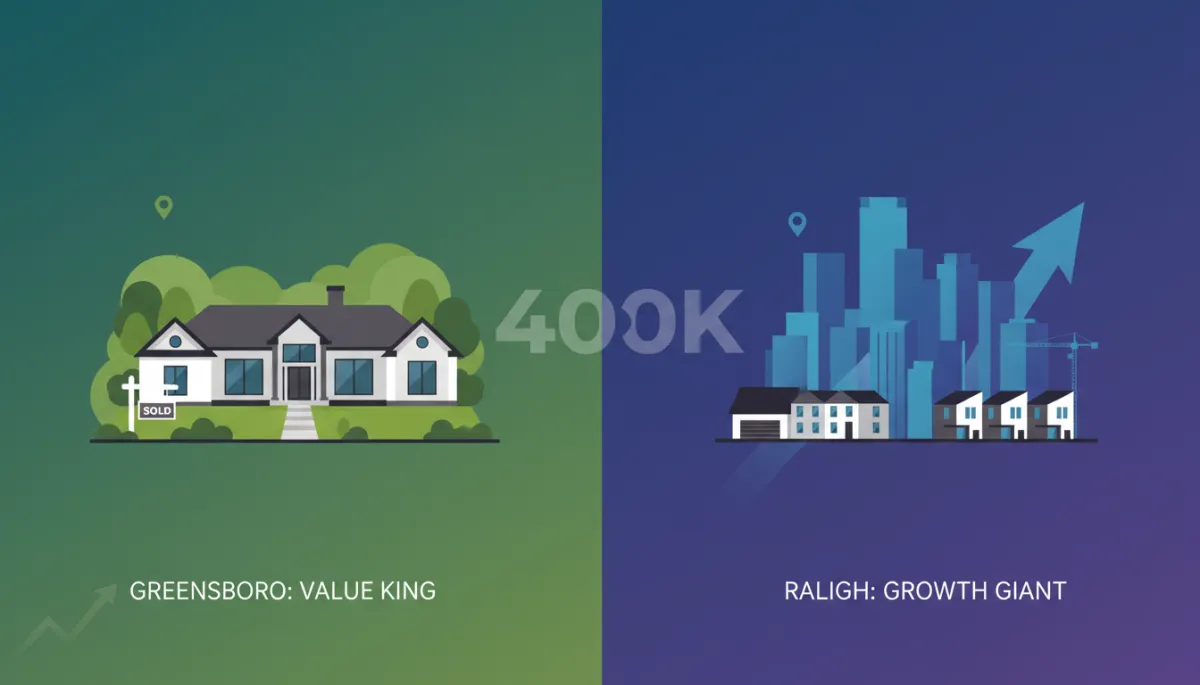
Greensboro vs. Raleigh: $400k Home Value in 2026
Real Estate, North Carolina, Greensboro, Raleigh, Home Buying
Greensboro vs. Raleigh: Where Does $400k Go Further in 2026?
With both Greensboro and Raleigh stabilizing after the frenzy of the early 2020s, a $400,000 budget looks very different in each city. If you are weighing space versus location, lifestyle versus career growth, this side‑by‑side guide will help you decide where your money – and your future – goes further in 2026.
What $400,000 Buys in Each City
Start with the basics: overall price levels. In early–mid 2026, the typical home value in Greensboro sits around the mid–$250,000s, with median sale prices near $285,000–$289,000 according to Redfin and regional reports. Raleigh, by contrast, posts a typical home value around $425,000, with median sale prices in the low– to mid–$420,000s based on Zillow and Redfin data. In other words, $400,000 puts you above the median in Greensboro but slightly below it in Raleigh.
In Greensboro’s more balanced, buyer‑friendly market – where inventory is up roughly 20% year‑over‑year and homes sit about 60+ days on market – $400,000 gives you leverage and choice. In Raleigh, where inventory has also risen but demand stays strong thanks to job and income growth, $400,000 is still competitive but often requires trade‑offs on size, finishes, or commute.
Square Footage: Space vs. Location
Because Greensboro’s median prices hover around the high $200,000s, a $400,000 budget typically stretches into the upper‑tier of its single‑family market. With price‑per‑square‑foot figures near $185, buyers routinely find:
2,400–3,000+ square feet
Four bedrooms, often with a bonus room or office
Larger lots, garages, and outdoor living space
In Raleigh, where median values are roughly $425,000, $400,000 often buys a smaller home or townhome, especially inside or near the Beltline. Think:
Roughly 1,600–2,000 square feet in many close‑in areas
Three bedrooms, sometimes two plus a flex room
Smaller lots or shared walls in townhome communities
If maximizing square footage is your top priority, Greensboro clearly wins. If being 10–20 minutes from a major tech job cluster or urban amenities matters more, Raleigh’s smaller, location‑centric options may still feel like the better use of your $400,000.
Greensboro: The “Value King” for Space and Upgrades
Greensboro’s 2026 market has cooled from earlier spikes, with appreciation moderating to the low single digits and more sellers trimming prices. That environment favors buyers with mid‑to‑upper budgets. With $400,000, you are shopping above the city’s median sale price and can often focus on spacious, recently updated homes in established neighborhoods or high‑amenity suburbs near lakes and parks.
Expect move‑in‑ready kitchens, refreshed baths, newer roofs and systems, and perhaps even a finished basement or bonus room. Because inventory is up and days on market are longer, buyers can negotiate on closing costs, repairs, or minor cosmetic updates, stretching that $400,000 even further. For households wanting elbow room, guest space, and a yard without stretching to luxury price points, Greensboro earns its “Value King” title.
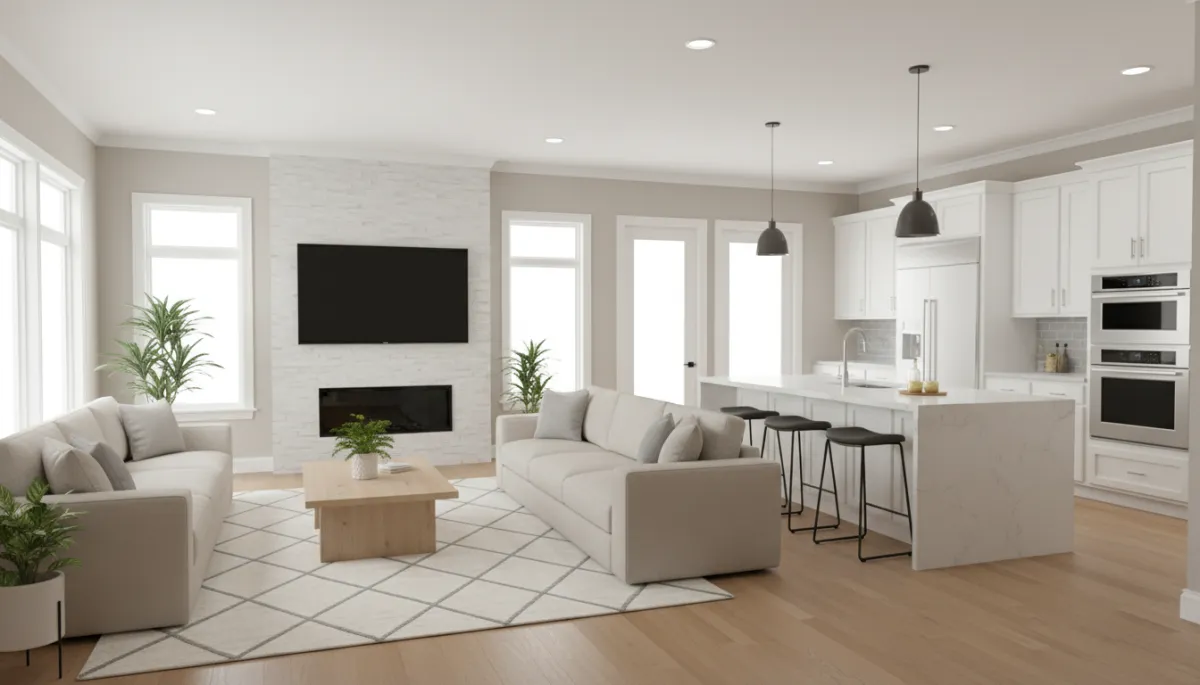
In Greensboro, a $400,000 budget often delivers generous square footage and fresh updates.
Raleigh: The “Growth Giant” Focused on Location
Raleigh, on the other hand, is a classic “Growth Giant.” Even as year‑over‑year prices have flattened or dipped slightly – Zillow notes a roughly 2–3% decline over the past year – the city remains a magnet for talent, with strong job and income growth and continued in‑migration. That demand keeps land and central locations expensive, so $400,000 tends to buy smaller homes that trade square footage for proximity.
In practical terms, you are often choosing between a compact single‑family home in an older but walkable neighborhood, or a newer townhome or condo a bit farther out, but still close to major job corridors. Many buyers accept less space in exchange for shorter commutes to Research Triangle Park, downtown Raleigh, or the North Hills area, where major mixed‑use and even 55+ communities are expanding.
New Construction Trends: Where Are Builders Betting?
In both cities, builders are responding to higher rates and shifting demand, but in different ways. Around Greensboro, rising inventory and a more balanced market mean new construction is often positioned as a value play: slightly smaller than sprawling resale homes, but with modern layouts, energy efficiency, and builder incentives that can keep total ownership costs attractive around the $400,000 mark.
In the Raleigh metro, construction has been intense in recent years, especially in townhomes, condos, and multifamily. While apartment deliveries have slowed in 2026, the pipeline of attached housing and master‑planned communities remains strong. For a $400,000 buyer, that often means:
New or nearly new townhomes with modern amenities but modest yards
Smaller single‑family homes in outer suburbs with community pools, greenways, and shared amenities
Builders in Raleigh are effectively selling lifestyle and access as much as square footage, which aligns with the city’s long‑term growth story but can feel tight for buyers who crave more space.
Property Valuation and Investment Potential
From an investment standpoint, Greensboro and Raleigh play different roles in a portfolio. Greensboro’s homes are comparatively affordable, with solid rent yields (around 6.5% in some estimates) and forecasted price growth in the 2–4% range. PropertyIQ notes only modest overvaluation and stable fundamentals, making Greensboro appealing for buyers seeking cash‑flow and long‑term stability.
Raleigh, by contrast, is more expensive and flagged as more overvalued relative to local incomes. However, its strong job base, income growth, and continued in‑migration support long‑run demand. Even with recent softening, the market is viewed by many analysts as entering a phase of normalization rather than decline. For investors and owner‑occupants alike, Raleigh looks like a classic growth market: thinner cash‑flow today, but potentially stronger appreciation over a 7–10‑year horizon, especially near transit, universities, and major employment hubs.
Lifestyle Considerations: How Do the Cities Feel Day‑to‑Day?
Space is only part of the story. Greensboro offers a slower‑paced, mid‑sized‑city feel with strong access to parks, lakes, and family‑friendly neighborhoods. With a $400,000 home, you are likely hosting gatherings in a big backyard, setting up a home office or gym, and enjoying easier parking and less congestion. For many buyers – especially those working remotely or commuting within the Triad – this lifestyle balance is hard to beat.
Raleigh leans more urban and career‑driven. Its restaurant scene, cultural events, universities, and proximity to Research Triangle Park attract a younger, highly educated population. Living closer in, even in a smaller home, often means shorter commutes, more walkability, and quicker access to nightlife, networking, and professional opportunities. If your calendar is full of meet‑ups, conferences, and client lunches, Raleigh’s “Growth Giant” energy may outweigh the sacrifice in square footage.
Lifestyle vs. Career: Which City Aligns with Your Goals?
Ultimately, choosing where your $400,000 goes is as much about your life stage and career path as it is about numbers. Ask yourself:
Is my job flexible or remote? If yes, Greensboro’s larger, updated homes may dramatically improve your daily comfort and budget.
Am I prioritizing career acceleration? If you work in tech, life sciences, or high‑growth industries, Raleigh’s ecosystem could open more doors, even if your home is smaller.
Do I value quiet and space, or buzz and access? Greensboro leans toward calm and room to spread out; Raleigh leans toward energy and opportunity.
The Bottom Line: Where Does $400k Go Further in 2026?
In pure housing terms – square footage, updates, and negotiating power – Greensboro is the clear Value King. Your $400,000 can secure a spacious, recently updated home in a stable, moderately appreciating market with solid rent potential and room to grow into the property over time.
In broader life‑planning terms, Raleigh remains the Growth Giant. You will likely sacrifice space, but gain proximity to a thriving job market, a deeper bench of employers, and a city whose long‑term economic trajectory still looks strong, even as prices cool to more sustainable levels.
If you are seeking maximum home for the money and a calmer pace, point your $400,000 toward Greensboro. If you are betting on career upside and long‑term metro growth – and can live with a smaller footprint – Raleigh may still be the smarter long‑game move. In 2026, both cities offer opportunity; the best choice is the one that matches your lifestyle, your career, and your vision of “home” over the next decade.
