
Fall 2026 Forecast: Rates, Weather & Economy
Economy, Weather, Interest Rates
Fall 2026 Triangle Forecast: What Happens When Rates Stay Put Through 2027
As a very strong El Niño reshapes the Fall 2026 weather pattern and central banks signal higher-for-longer interest rates, households and businesses face a rare “triangle” of forces: climate, credit, and growth converging at the same time. Here’s what that means for the season ahead and for an economy living with steady rates into 2027.
The “Triangle” Shaping Fall 2026
The Fall 2026 triangle forecast brings together three big storylines: a very strong El Niño driving unusual weather, a higher-for-longer interest rate stance, and a moderating but still growing economy. Taken together, they will influence everything from heating bills and harvests to borrowing costs and hiring decisions.
On the climate side, NOAA’s Climate Prediction Center puts the odds of a very strong El Niño above 90% for fall and winter 2026–27, with some estimates suggesting it could rank among the strongest events on record (NOAA CPC; AP News). At the same time, Federal Reserve projections and market commentary point to policy rates staying elevated through at least the end of 2027, even if the exact level is debated.
Fall 2026 Triangle Forecast: How El Niño Rewrites the Season
For Fall 2026 (roughly September through November), the atmosphere is being steered by El Niño. When El Niño is this strong, it tends to shift the jet stream and supercharge certain storm tracks. NOAA’s seasonal outlook for October–December 2026 favors above-normal temperatures across most of the U.S. and Alaska, with particularly high odds in Southeast Alaska, the Northern Great Basin, and parts of the northern Plains (NOAA CPC).
That warmth is expected to arrive early. Mid‑July guidance for August–October already pointed toward above-normal temperatures for much of the contiguous U.S. (Iowa State Mesonet), and private forecasters like AccuWeather anticipate a delayed autumn chill as summer-like warmth lingers into early fall. In practical terms, many communities may see a shorter sweater-weather season and a longer period of air-conditioning bills.
Precipitation is the other key side of the triangle. NOAA projects above-normal rainfall from Southern California across the Four Corners, through the Plains, and into the Southeast and Mid‑Atlantic, with the strongest wet signal along parts of the eastern Gulf Coast and Southeast (NOAA CPC). October in particular could bring enhanced rain from the Southwest to the Gulf Coast, partly from tropical remnants funneling into the El Niño pattern.
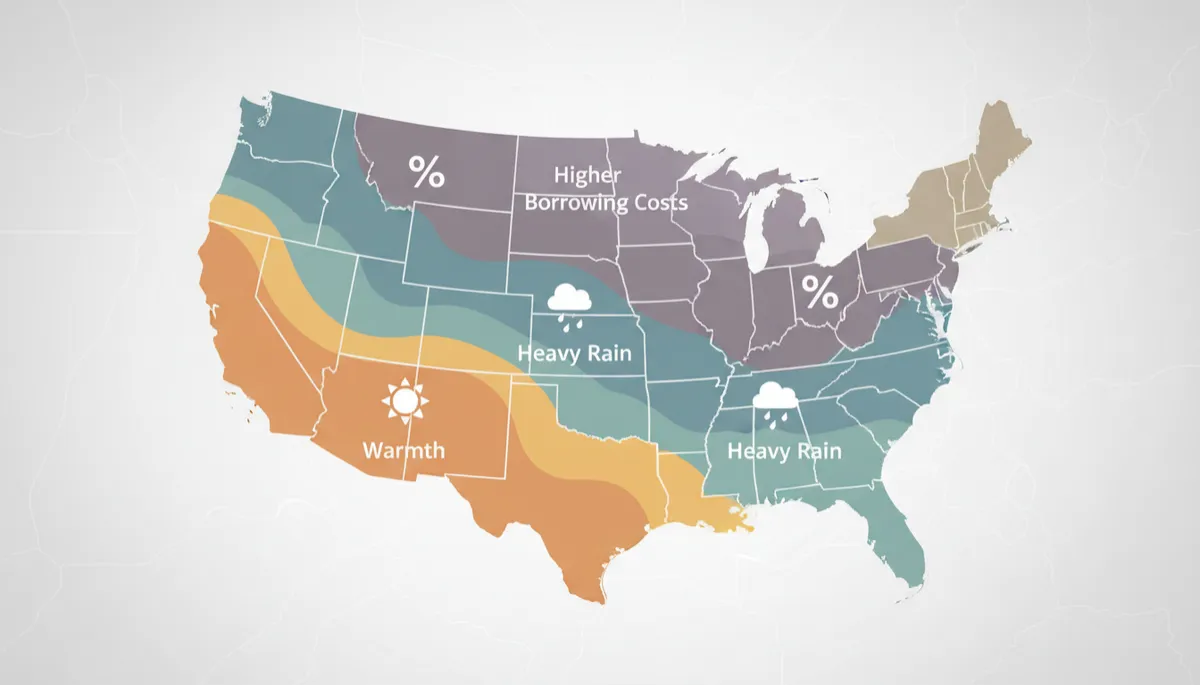
Weather, credit conditions, and growth converge this fall to shape local risks and opportunities.
Not every region shares the same story. The Old Farmer’s Almanac, while not a scientific model, suggests a cooler, wetter Northeast, cooler and drier conditions along parts of the Atlantic Corridor and Appalachians, and generally warmer interiors with drier pockets across the country (Old Farmer’s Almanac). Together with NOAA’s wetter‑South signal, that means elevated flood risk in the South and Southeast, while some northwestern and interior regions lean drier than normal.
💡 Pro Tip: If you live in the South, Southeast, or Mid‑Atlantic, review flood coverage, drainage, and emergency plans before peak fall storms arrive.
What Happens When Rates Stay Put Through 2027?
While the atmosphere is unsettled, interest-rate expectations are surprisingly stable. The central question for borrowers and investors is not “When do rates plunge?” but “What if they don’t?” Many projections now cluster around a scenario where policy rates remain elevated through 2027, even if the exact number is uncertain.
The Federal Reserve’s June 2026 Summary of Economic Projections pegs the median federal funds rate at about 3.6% by end‑2027, only slightly lower than 2026’s 3.8% (Federal Reserve). Other official forecasts, like the Kansas City Fed and the Congressional Budget Office, imagine a gentle drift toward the high‑2s or low‑3s by mid‑2027, while some private and market‑based views are more hawkish, with rates closer to 4.0–4.1% and little change through 2027 (Kiplinger; Reddit‑summarized dot plots).
Futures pricing as of mid‑2026 reflected expectations of the first rate cut only around October 2027, and some private banks, such as Goldman Sachs, see just two cuts that year—one in June and one in December—if inflation behaves (Goldman Sachs; AP News). Put simply, the consensus is shifting from “sharp easing” to “plateau, then gradual descent.”
Households: Higher Borrowing Costs Become the New Normal
If rates stay put through 2027, today’s borrowing costs stop feeling “temporary” and start to feel like the baseline. Mortgages, auto loans, and credit-card APRs are likely to remain well above the ultra‑low levels of the early 2020s. That can:
Cool housing demand in sensitive markets, especially where home prices also face climate‑related insurance pressures from flooding and storms.
Encourage more saving and less discretionary spending, as households juggle higher interest payments with potentially volatile energy and food bills tied to El Niño disruptions.
Make variable‑rate debt particularly painful if market expectations for cuts keep getting pushed out.
Businesses and the Broader Economy: Slower, Not Stopped
Economic forecasts for 2026–27 suggest that growth continues, but at a more measured pace. The IMF projects global growth of 3.0% in 2026 and 3.4% in 2027, while the OECD sees 2.9% and 3.0% respectively (IMF; OECD). For the United States, most forecasts cluster around roughly 2% growth in both 2026 and 2027, supported by AI investment and resilient productivity but challenged by energy prices and softer income gains (CBO; Federal Reserve).
In a world where rates stay put, companies face a prolonged period of higher capital costs. That can restrain speculative projects but favor investments with clear, durable payoffs—such as climate resilience, energy efficiency, and automation. For sectors directly exposed to the Fall 2026 weather pattern—agriculture, energy, construction, and insurance—the combination of stormier conditions in the South and tighter credit may accelerate the push toward risk‑management and adaptation spending.
📌 Key Takeaway: A very strong El Niño may deliver short‑term volatility in prices and activity, but steady policy rates through 2027 mean businesses should plan for a marathon, not a sprint, in managing borrowing and investment.
Navigating the Triangle: Practical Steps for Fall 2026 and Beyond
The Fall 2026 triangle forecast is not just a theoretical exercise. It points to concrete actions:
In wetter southern and southeastern regions, review flood risk, supply chains, and insurance ahead of the stormier El Niño months.
For households and firms with debt, consider locking in fixed rates where possible, assuming that elevated borrowing costs could last well into 2027.
For investors, a higher‑for‑longer world tends to reward quality balance sheets, steady cash flows, and sectors tied to adaptation, infrastructure, and technology.
As Fall 2026 unfolds, the intersection of powerful weather, steady policy rates, and a cautiously expanding economy will define the landscape. Those who read the triangle clearly—preparing for storms, budgeting for higher borrowing costs, and investing in resilience—will be best positioned to turn a challenging setup into an opportunity.
