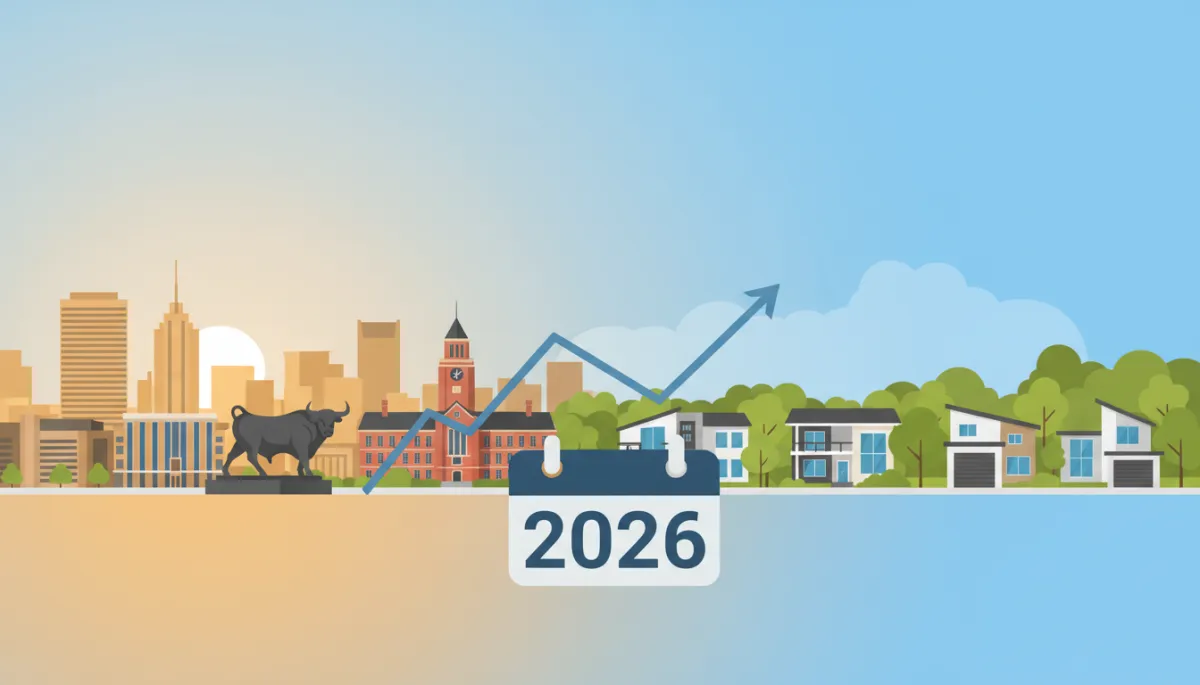
2026: Best Time to Buy in Raleigh-Durham?
Real Estate, Raleigh-Durham Housing Market
Is 2026 a Good Time to Buy a Home in Raleigh-Durham?
With prices cooling, inventory rising, and mortgage rates still elevated, buyers in Raleigh-Durham are asking a crucial question: is 2026 actually a smart time to buy, or is it better to wait? Here’s a clear, data-driven look at what’s happening across the Triangle so you can decide with confidence.
The Big Picture: A Strong Economy Behind a Cooling Market
One of the most important factors in deciding whether to buy is the region’s economic health. In 2026, Raleigh-Durham’s fundamentals remain solid. Southeast Economic Advisors projects real GDP growth of about 3.0% and nonfarm employment expanding by roughly 1.5% (about 19,000 new jobs) this year (Southeast Economic Advisors). Population is expected to grow by around 41,000 residents (+1.8%), and median household income is on track to reach about $101,500.
National outlooks from PwC and others continue to rank Raleigh-Durham among the top U.S. markets for job and income growth potential, which supports long-term housing demand even as the short-term market cools (PwC Emerging Trends in Real Estate 2026).
What’s Happening to Home Prices in Raleigh and Durham?
After years of rapid appreciation, 2026 looks very different. Across much of the Triangle, prices have either flattened or dipped modestly, giving buyers more leverage than they have had in a long time.
Raleigh: A Gentle Step Down from Peak Prices
In Raleigh, Zillow’s Home Value Index places the average home value around $435,237 as of July 31, 2026, down about 2.0% year over year (Zillow). Redfin shows a median sale price of about $421,000 over the three months ending July 2026, a 5.4% decline from the prior year, with homes selling in roughly 33 days (Redfin).
Realtor.com data paints a similar picture: a median listing price near $454,250, down about 4.1% year over year, and homes taking a median of 57 days to sell (Realtor.com). Inventory has grown, and July reports from Homes.com show home sales down 7.1% year over year and a 3.5% drop in median sale price to roughly $439,266 (Homes.com).
In short, Raleigh is no longer in a bidding-war frenzy. Prices are slightly lower, homes sit on the market longer, and buyers have more choice and negotiating power than they did even a year or two ago.
Durham: Sharper Softening and a “Two-Speed” Market
Durham has cooled even more noticeably. Mid-2026 data shows new listings down 4.4% year over year but inventory up nearly 19%. Both median and average sales prices are down around 7%, and homes average about 27 days on market (Tana Widdows – Triangle Market Report).
EasyDigz data for July 2026 shows a median closed price around $408,245, with homes that are well-priced and move-in ready closing in just over 12 days, while less competitive listings linger for roughly 49 days (EasyDigz Triangle Market Report). This “two-speed” pattern can favor buyers who are willing to look beyond the most polished listings or negotiate on homes that have been sitting for a while.
Cooling prices and rising inventory are slowly shifting the Triangle toward a buyer-friendlier market.
Mortgage Rates in 2026: The Biggest Headwind for Buyers
The other half of the “Is now a good time?” equation is financing. As of early September 2026, national averages for a 30-year fixed-rate mortgage hover around 6.6–6.8%, according to Freddie Mac and Bankrate (Freddie Mac; Bankrate). That’s the highest level in more than a year and a far cry from the ultra-low rates of the early 2020s.
Lender-specific data shows purchase rates typically in the mid-6% range for conventional loans, with some VA and FHA products coming in lower—sometimes in the mid-5% range if you qualify (LendingTree; Navy Federal; Yahoo Finance).
💡 Buyer Tip: In 2026, a slightly lower purchase price can help offset higher rates. Also consider strategies like paying points, using lender credits, or planning to refinance if rates drop in a few years.
Is the Triangle Becoming a Buyer’s Market?
Region-wide, the Triangle is rebalancing. Nest Realty’s mid-year report notes that Raleigh-Durham-Chapel Hill is shifting away from an extreme seller’s market toward a more balanced environment, with inventory up and mortgage rates in the low 6% range (Nest Realty). June 2026 data show closed sales up 9.1% across the Triangle and inventory up about 7.6%, representing roughly 3.7 months of supply (Raleigh Real Estate Search).
For buyers, this means:
More choices and less pressure to waive inspections or rush offers.
Better negotiating leverage on price, closing costs, and repairs—especially on homes that have been on the market for several weeks.
Less competition from investors and speculative buyers compared with the peak pandemic years.
What Do Forecasts Say About Buying Now vs. Waiting?
According to Southeast Economic Advisors, the region’s existing-home median price is expected to rise from about $432,000 in 2025 to $438,000 in 2026, and to around $451,000 in 2027—roughly 2.6% average annual growth over five years (Southeast Economic Advisors). The National Association of Realtors also lists Raleigh among its top U.S. “hot spots” for 2026, thanks to strong job and population trends (Axios / NAR outlook).
Put simply, most experts are not calling for a crash. Instead, they expect modest appreciation from today’s slightly lower base. If you plan to own your home for at least five to seven years, buying in 2026 means:
Entering the market after the steepest price run-ups have cooled.
Benefiting from expected long-term growth driven by jobs, income, and in-migration.
Having the option to refinance if and when mortgage rates eventually ease.
So, Is 2026 a Good Time to Buy a Home in Raleigh-Durham?
For many buyers, the answer is yes—with the right expectations and time horizon. Here’s how to think about it:
If you need to move for work, family, or lifestyle reasons and expect to stay put for several years, 2026 offers more reasonable prices and more negotiating room than the recent past—especially in softening areas like Durham.
If you are extremely rate-sensitive and your budget is tight, it may be worth waiting and watching mortgage rates, building savings, and improving your credit so you can secure the best possible terms when you do buy.
If you’re an investor or move-up buyer, the combination of cooling prices, solid rent demand, and strong regional job growth can make 2026 an attractive entry point—especially for well-located homes and multifamily properties.
📌 Key Takeaway: 2026 is less about timing the exact bottom and more about finding a home that fits your life and budget in a market that’s finally giving buyers some breathing room.
How to Make a Smart Move in 2026
If you decide 2026 is your year to buy in Raleigh-Durham, focus on what you can control:
Run the numbers carefully. Look at monthly payments at today’s rates, not yesterday’s. Make sure you’re comfortable even if rates don’t drop quickly.
Shop lenders aggressively. Small differences in rate or closing costs can significantly change your long-term cost of ownership.
Leverage the cooling market. Target homes that have been listed for several weeks, and don’t be afraid to ask for repairs, concessions, or rate buydowns from sellers.
Raleigh-Durham’s story in 2026 is one of transition: from overheated to balanced, from frantic to thoughtful. If you approach the market with clear priorities, a solid financial plan, and realistic expectations, this year can be an excellent time to put down roots in the Triangle—before the next wave of long-term growth pushes prices higher again.
